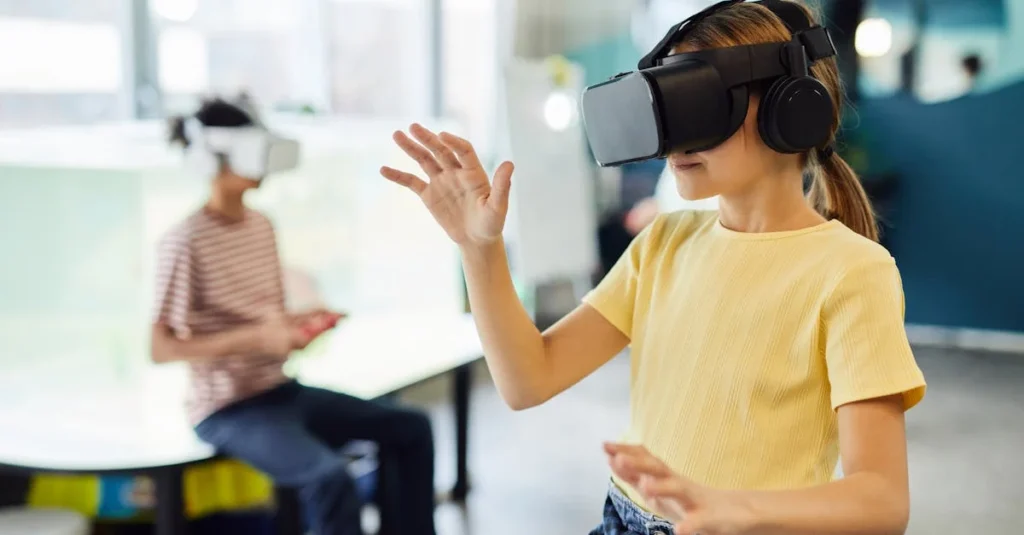
Imagine a classroom where history comes alive right before your eyes, where you can walk among dinosaurs or explore the far reaches of space without leaving your chair. Sounds like something out of a sci-fi movie, right? Welcome to the world of augmented reality (AR) in education. It’s transforming our learning landscape in ways we never thought possible. In this text, we’ll investigate into how AR is reshaping our educational experiences, offering countless benefits, applications across subjects, and even some challenges. So, let’s take the plunge into this exciting realm together.
Augmented Reality Education
Augmented reality is more than just a trendy buzzword: it’s a technology that layers digital information over our real-world environment. Think of those Snapchat filters that make us look like cats or add funky hats to our selfies. Now, apply that concept to education. AR uses devices like smartphones, tablets, or even specialized glasses to overlay images, sounds, and other sensory inputs on top of what we see. This enhances our perception of reality by adding meaningful context to our everyday experiences, making it a perfect tool for learning.
Benefits of Augmented Reality in Education
So, why should we care about AR in education? The benefits are as clear as the images AR generates. First, it enhances engagement. Human beings are visual creatures: when we see interactive elements, we become curious. Students who might otherwise zone out during a lecture are suddenly intrigued by dynamic models or 3D simulations. This leads to better retention of information.
Also, AR offers personalized learning experiences. It allows us to tailor educational content to fit individual learning styles. For instance, a visual learner can benefit from seeing complex processes unfold right before their eyes. This customization means we can meet diverse needs in the classroom more effectively. Overall, augmented reality is revolutionizing how we interact with educational material, and it’s creating a more inclusive environment.
Applications of Augmented Reality in Various Subjects
Let’s get specific. Augmented reality finds applications across a wide variety of subjects, each with unique benefits. In science classes, for instance, AR can make anatomy lessons immersive. Imagine dissecting a virtual frog in 3D rather than using a scalpel in a lab: students can explore layers and systems without the mess or ethical issues.
In history, AR can transport us back in time. We can walk through ancient ruins or witness pivotal historical events reenacted in front of us. It’s as if history class becomes a living canvas where learning feels significant and dynamic. Even in mathematics, AR can visualize concepts like geometry, making abstract ideas tangible. This makes it easier for students to grasp complicated theorems and formulas, bridging the gap between theory and real-world application.
Challenges and Limitations of Augmented Reality in Education
But, as with any emerging technology, augmented reality isn’t without its challenges. First, there’s the issue of accessibility. Not all schools have the funding to provide AR-ready devices. This creates a digital divide where only fortunate students can experience the benefits of AR-based learning.
Another concern involves the potential for distraction. When surrounded by flashy graphics and interactive elements, some students may lose focus on the lesson at hand. It’s all about balance: AR should complement traditional learning methods rather than overshadow them. Finally, there’s the need for adequate training among educators. Without proper knowledge on utilizing these tools effectively, embracing AR in classrooms becomes inefficient.
Future of Augmented Reality in Learning Environments
We can’t help but get excited about the future of augmented reality in education. As technology continues to advance, we’re seeing improvements in AR software, making it more accessible and affordable for educational institutions. Eventually, we might even see AR fully integrated into standard curricula, reshaping how we think about classroom learning.
The potential for collaboration among students across the globe through AR is also thrilling. Imagine a classroom in the U.S. connected with one in Japan, exploring cultural history together through virtual experiences. The possibilities are endless. We’re standing on the precipice of a revolution in how knowledge is shared, making education a more connected and vibrant venture.