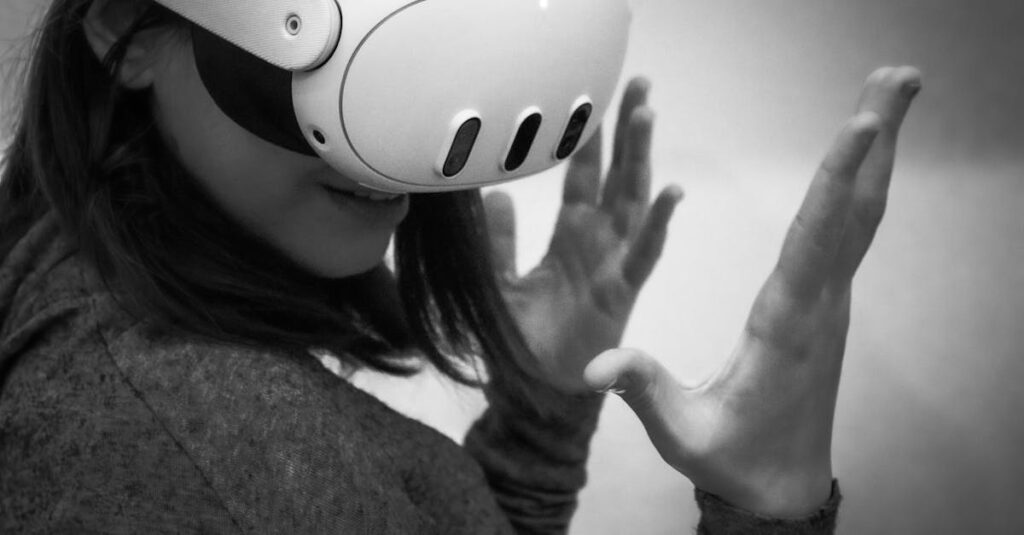
Imagine walking through a gallery where the paintings come to life, responding to your every movement. Funny, right? But this isn’t a scene from a sci-fi movie: it’s the captivating world of augmented reality (AR) art. In this digital age, we aren’t just passive observers anymore: we’re active participants. Join us as we jump into the fascinating realm of augmented reality art, where creativity knows no bounds.
Augmented Reality Art
Augmented reality art seamlessly blends digital elements with the physical world, allowing us to experience creativity like never before. Essentially, AR art enhances our perception by overlaying digital images, animations, and sounds onto real-world environments through devices like smartphones and AR glasses. Picture this: you scan a QR code next to a painting, and suddenly, vibrant animations dance across the canvas, giving us insight into the artist’s thought process. It’s a mesmerizing fusion of art and technology that engages our senses in novel ways.
The Evolution of Augmented Reality In Art
We can trace AR art back to its roots in the early 2000s, but it has truly exploded in popularity in recent years. Initially, artists experimented with basic overlays and gimmicky apps. Fast forward to today, and we see sophisticated installations that challenge our perceptions and invoke deep emotions. Merging virtual reality (VR) and augmented reality, artists like Refik Anadol and Marina Abramović have paved the way for a new generation of immersive experiences. Their work not only draws in spectators but also demands interaction, transforming the way we connect with art.
Key Features of Augmented Reality Art
What sets AR art apart? Let’s start with interactivity. Unlike traditional art, which is often static, AR art invites us to engage with it. We become co-creators, exploring layers of meaning hidden beneath the surface. Another essential feature is accessibility. With just a smartphone, we can view complex installations or immersive stories right in our living rooms. Also, AR art is constantly evolving: artists can update their works easily, responding to new information or audience feedback. This agility makes each experience unique and ever-changing.
Impact of Augmented Reality Art on The Art World
The introduction of AR has significantly impacted the art landscape, enhancing how we experience and interpret art. It breaks down barriers, allowing artists to reach broader audiences without the constraints of physical exhibition spaces. Museums, for instance, are increasingly incorporating AR into their exhibits, enriching our understanding of the pieces on display. Also, it sparks new conversations around art ownership and the value of digital versus physical works. As we rethink these concepts, AR helps democratize art, making it accessible to everyone.
Challenges and Limitations of Augmented Reality Art
Even though its wonders, AR art isn’t without challenges. Technical issues can arise, leading to frustrating experiences for us as viewers. Also, not everyone has access to the necessary technology, which can create a digital divide. There’s also the question of permanence: digital artworks are often transient, existing only as long as the platform supports them. Finally, copyright concerns loom large, with artists navigating a complex landscape of rights in a digital world. As we embrace this technology, it’s crucial to address these limitations.
Future Trends in Augmented Reality Art
Looking ahead, we see an exciting convergence of emerging technologies like artificial intelligence and machine learning in AR art. These advancements will enable us to create even more personalized and interactive experiences. Imagine art that responds to our emotions or personal preferences in real-time. Also, as AR technology becomes more integrated into everyday life, we anticipate even greater collaborations between artists and technologists, leading to groundbreaking projects that blur the lines between creator and spectator.